To know where you’re going, you first need to get lost

When I was ten, I remember spending an entire afternoon working meticulously on a painting for a school assignment. The topic was the May Day holiday. An important holiday during communism in Poland, celebrating work and labor. The whole nation celebrated, down to the school children. And few lucky students even got the chance to walk in a big parade, carrying white and red flags, dressed in bright white shirts and navy pants or skirts.

Although that year our class did not walk in the May Day parade, we still needed to mark the holiday somehow. So we were assigned to paint our own version of the celebration. As soon as our art teacher announced the assignment, the vision of what I was going to paint popped into my head. That afternoon, as soon as I got home, I took out my “bambino” crayons and lined them up from yellow to orange, then red, and purple, and blue, all the way to green, putting the brown and black colors at the very end. I took out a crisp white sheet of paper, the nice heavy weight stock. And I was all set to draw out my vision. I drew the most beautiful girls, with red lips, sparkly eyes and long eyelashes, dressed in traditional Krakowian costumes. They were dancing with boys wearing black boots and peacock feathers in their hats. The girls had long braids swinging in the air with ribbons and flowers woven into their hair. There was motion, energy, and everyone looked so happy. I even filled in the background so that there wouldn’t be any white spaces on the sheet. Color was beaming everywhere.

Sometimes one kind word or recognition can have immeasurable impact on our destination

But what I remember most about this day is the way my mom and my grandmother reacted to my picture when they saw it. Their eyes got bigger, and I saw them looking with amazement at my masterpiece. My mom congratulated me on the beautiful job, and my grandmother actually sat with me and looked at every person in the picture, describing how energetically they were dancing and how she saw the motion in the scene. I was overjoyed. As a child I rarely got praised. I was expected to behave and do what children were supposed to do. Praise was reserved only for special accomplishments. Something extraordinary. So getting such a reaction was rare and I held my picture close to me with pride and stared and stared at it until I fell asleep that night.

The next morning I woke up excited to show the picture to my teacher. She liked it and awarded me “a five”, the highest grade at that time. Other students in the class also liked my picture and they said that I was a good artist. When I went home that day I decided that when I grow up I was going to become an artist.

Knowing what you want requires first understanding of what we don’t want

At least that’s what I thought then. As it turns out, eight years later, when I applied to the Ontario College of Art, my portfolio got rejected, and my big plans of becoming a famous artist one day came crashing down. What was even tougher to swallow was that my friend who—at least on the surface—did not appear that passionate about art, ended up getting in with no problem. To make matters worse, two years later when I applied to work at an animation studio in Toronto, my portfolio and application also got rejected. So I put my dream of becoming an artist on a shelf and went to study languages instead at University of Toronto, and eventually got an MBA instead of an art degree.

However, I have never abandoned my passion for art. In fact several years later I did participate in an art exhibition at the Toronto City Hall, and even sold my art at couple of galleries. But at this stage it was more of a hobby than an art career.

Experiencing rejection can be one of the hardest lessons, but also a catalyst for progress

As difficult as it was to be rejected, the experience has taught me a great deal. It was a wakeup call that I needed to mature as an artist. Because up until this point, my parents, friends, and even teachers kept telling me that I was a great artist. And I am not saying that they were wrong. But what I needed was someone who has seen thousands of artists’ work, to tell me objectively that I simply did not have what it takes at this stage of my life to be an artist. And they did me a favor. Because it was still early enough in my life when I could easily pick a different path. Study other subjects, develop other interests and work on my other skills that would push me to become a well-rounded person. And in the end, the education I gained helped me land a great job that gave me great satisfaction.

And just because I was rejected by an art school, and have not chosen my first career to be in art, does not mean that I stopped being an artist. An artist is who I am because I feel it within me. I feel the desire to paint, and I paint and draw almost daily. I create because it’s what I feel I must do. Not because someone pays me to do it or because someone asks me to, but because without art my life would have a big empty hole. Each time I create art, that hole gets smaller and smaller and I feel happier.

To appreciate highs, we need to understand the lows

Once a year my family and I drive to Toronto. It’s at least a ten hour drive. Having done this drive for many years I noticed that once we get to the flat part of the journey, after passing Pittsburgh and heading towards Erie, each mile feels like ten. When we drive through the Appalachians, the trip moves faster. There are valleys, mountains, and interesting rocks to look at. The terrain goes up and down, and the landscape constantly changes. At that stage of the drive everything seems to be moving quicker. But the moment the terrain gets flat, the journey feels slow and weariness starts to hit me. And what is the smallest section of our trip, starts feeling like the longest.

Similarly, without the valleys in our own life, it is difficult to appreciate the peaks. Our successes feel bigger because of the lows we first go through to get there.

Sometimes what we think we want is not what we need.

And as I look back, I recognize that without experiencing rejection, I would not appreciate acceptance. I wouldn’t have become the artist that I am today. Not being accepted to the Ontario College of Art, pushed me to experiment more with art. To try different media, test various color combinations, and keep trying to reinvent my style.

Being turned down, also helped me become bolder and open to try different approaches because I no longer felt fear of being rejected. I had nothing to lose at that stage, but only to gain. With nothing to lose, I felt free to try whatever I wanted, and that’s when I unleashed my creativity and found the style that reflected the world within me. The style I paint in today.

About the Illustration: Lifted
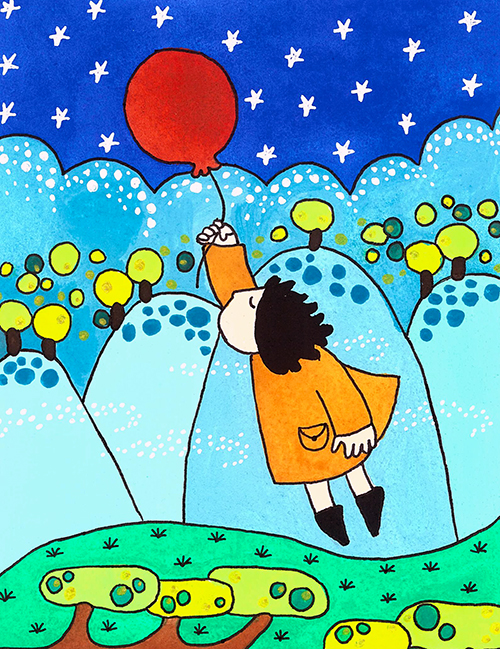
Girl with a red baloon_Rokita

This is how I imagine the moment of letting go. The moment when you’re no longer weighted down by the heaviness of all that keeps you down from being free to explore the essence of who you are.

The red balloon symbolizes the heart. The heart is what gives us lift. Without air, the balloon can’t float. And it wouldn’t lift the little girl in the picture above the valleys and the peaks either. Similarly to a balloon needing air to float upwards, the heart needs freedom to be lifted. The heart is fragile, like the balloon. Even the smallest sharp object can prick the thin surface of the balloon and it will pop and drop down. The heart too needs gentle handling.

As children, we naturally follow our hearts because there are no filters nor walls to block us from following it’s free flowing current.  Then we enter school and learn to use our minds and how to be sensible in order to function within our societies and cultures. Developing our mind is just as important as letting our heart be free. But both need to be nurtured. Neglecting one or the other eventually leads to imbalance and then pain. As we mature, our strength resides in our ability to find harmony between sensibility and our own heart. Finding an accord between the two is the strength we need to carry us over the valleys, and experience the highest of peaks. The girl in this picture has found harmony between her heart and her mind and therefore in this moment she is lifted.

When life gets hard, continue moving forward

On April 2nd this year, I participated and finished a 10 mile (16.09 kilometers) Cherry Blossom Run in Washington D.C. Initially I was not planning to participate in this race. I already completed it several times, nine years ago, and was not interested in spending my weekends on training for this agonizing run. Especially in the winter months leading up to the race. So when registration opened up for the race, and then closed at the end of February, I was not registered to run.

That’s until on March 29th, three days before the race, I found out that one of the runners from my office, who was registered for the race, had to go out of town that weekend and could no longer participate.

Even the toughest challenges can be conquered when you have a team you can count on

To explain the background further, we recently learned that one of our close colleagues from work was diagnosed with a very aggressive type of cancer. He was an athlete all his life. He eats healthy, exercises regularly, and is an inspiration to many of us who want to get into shape. He registered for the race before he found out about his grave illness. And the idea of not participating in it, was just another hit, out of the many he received in a span of few weeks.

To show support, several runners from our office decided to run in his honor. They made team jerseys and red rubber bracelets bearing his name. The group also organized regular training sessions, during lunch, to prepare for the race. I joined them on the shorter ones, three miles or less, but was not in shape to participate in the five or the six mile stretches.

However, when one of our colleagues was no longer able to do the run, the team organizer reached out to me. Knowing that I was also a runner, and that I did the race before, she asked me if I would take the other runner’s place. She also shared with me other unexpected news. Apparently our sick friend was going to run the 10 miles after all, despite his condition.

All of a sudden I had a decision to make. Do I want to try and run despite being out of shape? Do I come to the race that morning and stand on the sidelines to cheer for our team? Or, do I make an excuse, stay home on Sunday morning, in the comfort of my warm bed and enjoy a relaxing morning while I have my coffee and Belgian waffles?

We don’t always have the luxury to prepare for what’s ahead

The more I thought about my options, the clearer it became to me that I needed to do this run. After all, my friend who has cancer was running in it, and his odds were even worse than mine. Also, he didn’t have a chance to prepare for cancer either. Like most of us, he was going about his life, when suddenly he found out that he had this vicious killer inside of him. He did not practice for the chemotherapy sessions. He was not training for the way the harsh drugs were going to impact his body. No one prepares for the battle with cancer.

Thinking about his situation, I decided to leap in. And try to run as much as I could. Even if I had to walk a portion of the race, I was going to be there. Running with the whole team. Doing something that’s not comfortable, and that’s not convenient. But doing it to be there for him and encourage my friend to not give up on his even tougher battle ahead.

On the morning of the race when I woke up at 5:00 am, groggy and wishing I could sleep longer, I was dreading what was still ahead of me that morning. Then thoughts like, “what am I doing?” and “what if I get injured?” were popping in my head. But, as I collected myself and had some coffee, my enthusiasm started coming back, and my doubt slowly dissipated.

At the start line, it was exciting to stand among our whole team and telling my friend that “he can do this!” His smile was so big that for a moment he didn’t look at all like someone who had cancer. Also, seeing all types of runners and feeling the energy in the air, reassured me that I was doing the right thing.

Step by step, mile after mile, as long as you’re going forward, you will keep getting closer to the finish line

The first three miles were easy. I still had the energy and my legs were holding up. However around mile five, I started to feel the pain in my legs. When I reached the five-mile marker, I felt like I have already run 20 miles. The idea that I still had another five miles ahead, terrified me. I started to think that maybe I should just walk the rest of the way, or just stop now and go home. But, looking at the people around me, and my team, as they kept running, helped me continue on. All of a sudden we reached a stretch with all the beautiful cherry blossoms in full bloom. I looked up and saw pink flowers falling like pink snow all around me. It was so beautiful to see the pink petals dancing in the breeze. I was no longer looking at the concrete underneath my feet, but instead I focused on the scene above the racers, and took time to appreciate the beauty around me, rather than think of the pain I was feeling.

But, by mile seven it hit me again. This was probably the hardest stage, because I felt like all my energy was spent. And yet I still had three more miles to go. I was ready to stop and walk the rest of the course, when all of a sudden I heard musicians playing on the sidelines. Their loud drums filled my heart with enthusiasm. The sound of music made me somehow feel lighter. Their music kept me going and upon reaching mile nine, I knew I could do this. I knew I could finish and reunite with my friend at the finish line and show him my support. Thank goodness for music and those wonderful musicians.

To do something significant requires endurance and determination

Running the 10-mile Cherry Blossom race and thinking about my friend and the tough battle in front of him, helped me realize that to do anything significant in life requires endurance. I am not a professional athlete. I wasn’t prepared to run such a long distance. But I ploughed through regardless, the best way I could. And with some determination and endurance, I was able to get through and reach the finish line. Just like I have faith in my friend who, thanks to his endurance, will conquer this cancer.

And similarly to a long race, getting through the hard times in our life requires endurance and determination. To plough through to the other side. And even when it seems we can’t go any further, we must at least give it a fair effort.

Instant gratification erodes our endurance

The trouble is that many people expect quick results. And in the age of technology where instant gratification is part of its allure, we’re conditioned to think that there is an app solution for all of our problems. And that magically, with a few clicks and slides, we can do and get anything we want. A new job will materialize if we send in our resume through a powerful job-searching app. A new girlfriend or a boyfriend will appear at our doorstep if we swipe right. Or, a perfectly sculpted body will emerge, if we get that training app and exercise for the month of January. Meanwhile, the fact that it took years of unhealthy eating and sedentary lifestyle to become overweight in the first place, is suddenly forgotten. And, it will probably take at least half that time to start seeing any results. In fact, staying in shape is a lifestyle choice, for the rest of your life, not just a five-week exercise plan.

If you want something exceptional, it will take exceptional effort

Beginnings are often the hardest. Especially when we get accustomed to certain habits that we suddenly need to change. Having to give up the daily soda or beer, can feel like a drug withdrawal the first week or two. Leaving a comfortable office job in order to open a café can be scary. Especially when at first cash flow is very slow. An average business, if it survives, takes five years minimum to break even and requires hard work and determination to stay competitive. Sure it’s easier to show up at the office each day, doing the same predictable task. But staying in the comfort zone because it’s easier that way, and putting aside your dreams of making the best coffee in the world, only leads to average.

For many, good enough or average can be all they ever need to stay happy. However, for those who want something more out of life, something above average, an average office job, relationship out of convenience, mediocre education or idea is not going to cut it. Anything that is significant and above average, requires above average effort, above average work, and most important, endurance to make through the obstacles that stand between you and your dreams. The choice is yours, you either continue doing what’s comfortable, or you endure some discomfort for the chance to experience some of the happiest moments of your life.

About the picture: Sleepy Meadows at the foot of the Mountains

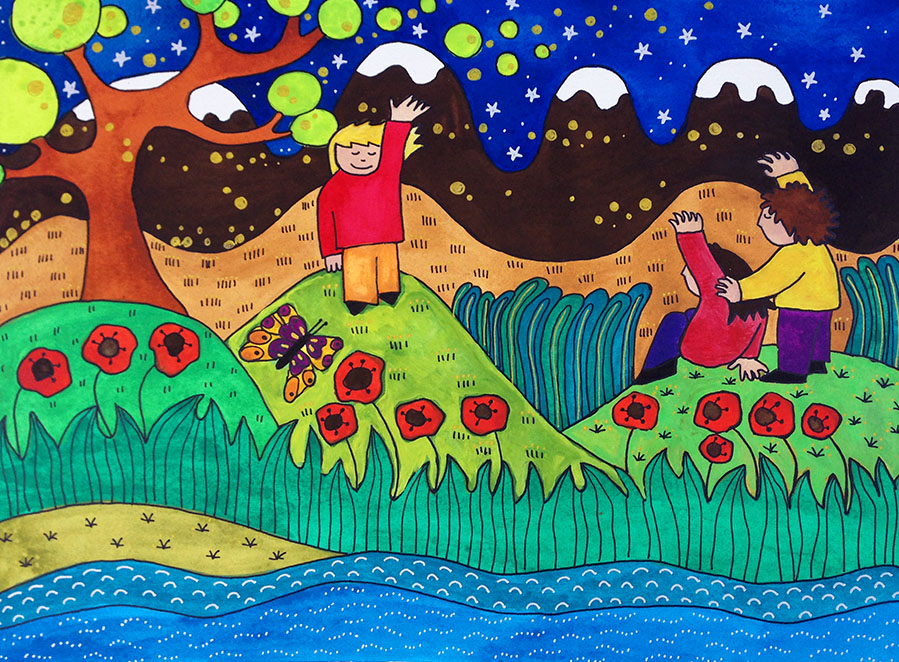
Sleepy meadow_Lange

In this picture, a boy on the hill is waving goodbye to his friends who are resting on the meadow filled with red poppies. The poppies symbolize sleep and represent a world that’s in a haze. A place where it feels like time has stopped. Something inside the boy ignited his wanderlust, and prompted him to leave. And now he must say goodbye to the pastures he played in for many years, and the familiar paths he walked each day. He is leaving a world that can no longer keep up with him. His curiosity has awakened and he desires to expand his realm.

But he is also struggling with his decision to leave all that’s familiar to him. To symbolize his hesitation, his body still remains facing his friends and the sleepy meadow. He knows he will miss them and the comfortable world he’s leaving behind. But he also knows that if he stays, he will succumb to the sleep and lose his motivation and ambition. Like the butterfly, his time is quickly fleeting and he must leave now, while he has his chance. Facing his back, are the mountains ahead. They are like a dark wall that stand between his current comfortable life and the dreams that lie beyond them. The mountains symbolize the challenges ahead. He will need to face and overcome those challenges to get through to the other side and fulfill his dreams. He will need determination and endurance to make it through.

Trust your Instincts

It was a cold winter day. No one wanted to go outside and play. But I insisted on going outside to play in the snow, despite my grandmother’s pleading for me to stay home. I was about seven years old. My mom was working during the day and my father was in Russia on a work contract, so my grandmother took care of me most days.

Winters in Poland are known to be brutal, but during communism, and especially that year, the winter was unusually hard for our family. Hot water was rarely available. Electricity was shut off at least once a week. Coal, to warm up our house, was difficult to get. And my mom couldn’t even buy me a pair of winter boots because of shortages. So I wore a pair that was too small and pinched my toes.

Despite this, I pushed and pushed my grandmother until she gave in and let me go. Of course, as a typical mom and grandmother she worried about my survival in the wind and the cold, so she wrapped me in several layers of wool sweaters, hat and mittens, and a coat two sizes too big, so that only my eyes were peering. Then sent me off into the wild winter wonderland, forcing a thick slice of rye bread with a layer of schmaltz topped with sugar, into my hand.

She was right, not a single soul was wandering outside. Even the black noisy crows were hiding somewhere. It was silent and lonely. I searched for things to do, and the best diversion I could think of was to ride my sled down the hill in front of my house. But after about a dozen times, I got bored of it. I parked my sled on the sidewalk next to my house, and started making snow balls and stacking them up. I became so absorbed by what I was doing that I didn’t notice a big figure standing right next to me.

I turned around and saw a man towering over me. He smiled and said that my mom was calling me and he came here to fetch me. I felt uncomfortable. Something didn’t feel right in my gut. So I didn’t say anything and just stood there frozen.

He kept saying how we need to hurry because my mom will be upset if we’re late. He was very convincing and had a calm voice. Yet something inside kept telling me that this was not right. I deliberated for a moment, and the first thought that came to my head was my grandmother. I was confused and needed her guidance. A sudden urge to run to my grandmother came over me.

I told the man that I need to go home first to tell my grandmother that my mom is calling me. He insisted that he spoke to my grandmother already and that she knows he’s taking me to my mom. He grabbed my hand and we started walking away and across the street. But my gut kept telling me that this was wrong. I don’t know how, but somehow I managed to slip away my arm and started running towards my home. He followed me quickly, but I ran as fast as I could, not looking back, straight for the door. I started yelling, “babciu, babciu” (grandmother in Polish), as loud as I could. She came right away, slightly out of breath and confused, asking me what happened. I told her that a man wants to take me to my mom and that he’s waiting right there. When I turned around, the man was gone. The street was empty. No one was there. But he was right there, I kept insisting to my grandmother. Her face turned somber, but she kept her cool and gently walked me into the house and asked that I stay inside for the rest of the day. I did not fight her this time.

Obey your instincts rather than those who don’t have your best interests at heart.

To this day I remember that feeling in my gut. This overwhelming sensation to get away from this man. Yet, at the same time I remember thinking that I needed to do what my mom wanted me, and go to her as the man instructed. Looking back, I am glad I followed my instinct instead of obeying. As it turned out, my mom was not calling me, did not send a man to fetch me, and that year many children disappeared without a trace in the area.

Stop wasting your energy on going against your nature.

Our instinct can be a powerful friend. And it’s important to listen to it. We often spend time analyzing situations, looking at numbers, facts, pros and cons, but with all that noise, we often forget to listen to our own gut. Or, we choose to ignore the voice inside, because it’s telling us something that we don’t want to hear or admit. So we push, despite of ourselves, to have something that we view as desirable, only to find out later that it makes us unhappy.

As children, our instincts are still pure. There are very few filters in place to muffle the voice inside. Therefore, as in my case, it was easy to hear the alarm sounding off in my gut, telling me to run as fast as I could when a strange man came up to me. But as we get older, the outside noise gets louder and louder, making it difficult to hear what we feel deep inside. As adults, the threats are often not as obvious. They don’t come in the form of some creepy stranger we need to run away from. Instead, the threats are often disguised as alluring situations, but end up leading us into the ditch. We might think that landing a job in a Fortune 500 company is the best thing that ever happened to us, only to find out later that the constant 60 hour work-weeks end up deteriorating our health or damaging our relationships.

Plus, we are told that it’s more sensible to become an accountant, when all we really want is to become an artist or a cowboy. We’re told that to be successful we must have a fancy car, a corner office in a posh building with marble floors, a perfectly sculpted body, and wear designer clothes. In essence, we must have more and more things rather than do more of what makes us excited.

And so we go against our core, because someone else’s expectations are pushing us in the opposite direction. This pressure can come from many sources: cultural, religion, family or friends. Even from television commercials, promising us the ideal life if only we follow their script. If only you buy your girlfriend that diamond ring, your relationship will be better. If only you buy your spouse that luxury car, they will be happier. And if only you drink that particular brand of beer and wear those slim-fit jeans, your parties will get better and the girls will stick to you like glue.

Many of us fall for that script because we see a bunch of smiling people when they have that coveted car or beer in their hands. But it’s not our own script. It’s one written by someone else. Someone who: first of all, works for the company which goal is to sell as many of their latest widgets as possible; second, is not in your shoes, and third, does not care about you as an individual and does not know who you are and what makes you happy, because perhaps they lived hundreds of years ago in a different country and time, when they were drawing up a policy that happens to impact your current life.

Go somewhere quiet and write your own script for happiness.

Only you have the potential to find out what makes you happy. But finding happiness is tough because it requires work to isolate your voice and then even more work to write your own script. Isolating your voice from the chorus can be challenging, because between the constant feed of media messages telling you what should make you happy, and society’s pressures, it is difficult to differentiate between your own voice and everyone else’s. Just like it’s difficult to hear your own self in a crowded bar.

So, if you want to hear yourself, maybe it’s time to step outside of that noisy bar and take a walk. Change the scenery. Take a day off and go on a trip or a hike. Take a vacation. And start tuning into your own frequency on a regular bases. And if you don’t have a lot of practice in writing your own script, it will probably take several versions before you get it right. But keep on trying. Like an artist who is learning to draw a figure, it takes a lot of drafts and years of practice before you get it close to what will please you.

Listen to your instinct and do more of what excites you.

A great way to start: spend more time with the people who excite you; learn more about the topics that excite you; take classes that excite you; read books that excite you; go to places that excite you, and so on. Follow the excitement you feel when you’re about to do something, and let your instinct guide you when to turn or when to move forward.

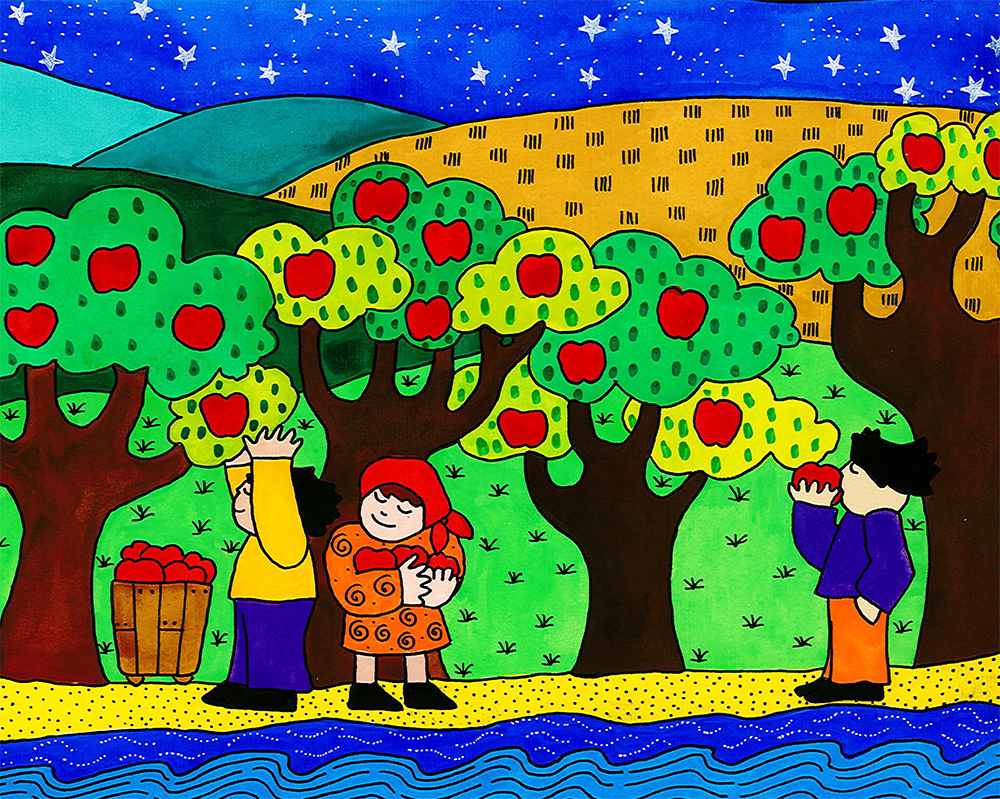
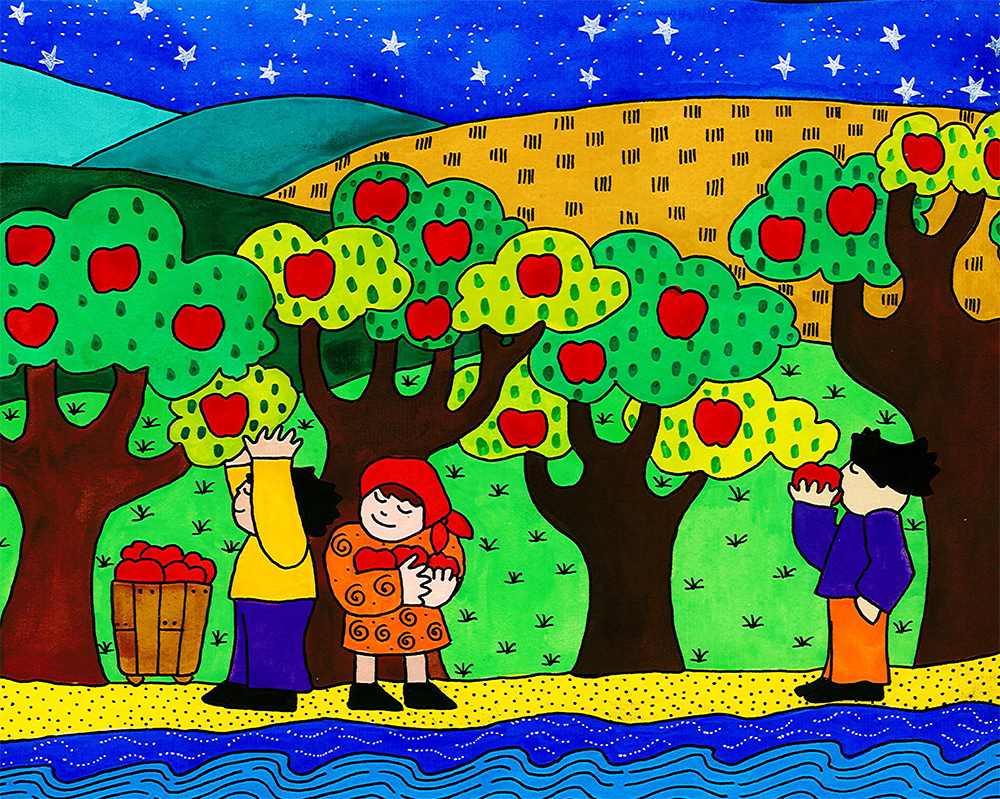
About the picture: Apple picking 

Picking Apples_Ola 2017

In this picture, I painted an orchard, full of ripe apples ready for picking. A girl found some apples on the ground and is now carrying them away. She does not want to share her apples with anyone and tries to hide them in her arms. A boy also found an apple on the ground, but rather than saving it, he is eating it right away. He does not care for picking apples. He prefers to eat the ones he finds along the way, instead of working hard for them by climbing the tree to gather the juicier ones on top. A boy on the left is making an effort to pick his apples. He stretches his arms as far as he can to reach the apples on the lowest branch, and collects them into his basket. And even though all the apple pickers have apples, they are only picking the ones close to them, while hundreds of delicious and juiciest apples hang out of their reach, still unpicked. The person who either brings a ladder or is willing to climb the tree, will be able to enjoy the best apples.

Opportunities, like those juiciest apples, often can’t be seen or reached from the ground. Sometimes we need a creative solution, like a ladder to help us access what’s on top, and at other times we need to put in hard work, such as climbing the tree to access the top fruit.

In this picture, I also decided not to paint anyone looking up. This is because I wanted to show that the apple pickers can only see the apples that are directly in front of them. They don’t look up and therefore miss all the apples right above them. Similar to our instinct, just because we can’t see it, it doesn’t mean it’s not there. We just need to adjust our angle, look up once in a while, and we just might find the prize we’ve been searching for, right above our head. Don’t be afraid to look and to listen.

Learning the Art of Balance


About two years ago I begun baking my own bread. Not because I like to bake, but because I didn’t want to eliminate bread out of my diet. After moving to the U.S., I noticed that something was affecting my digestion. I just didn’t feel right. I discovered, after a process of elimination, that breads and baked goods in North America were upsetting my stomach. This feeling became especially evident when I travelled between Europe and the U.S.

What’s up with our wheat?

While I was able to indulge in pizza, bread, pasta in countries like Italy or Poland, without feeling any discomfort, the moment I got back to the U.S. and ate the very same things, I started to feel bloated and low on energy. After eating a slice of local pizza or pasta, I felt like a heavy brick was sitting in my stomach, and I would get a stomach ache. And no, gluten was not the culprit, like many have suggested. The foods I ate in Europe had plenty of gluten and they did not affect me in the same way. And I did a celiac test just to be sure.

The bottom line is that in order to feel better and continue eating bread, I started baking at home with flour that was not genetically modified. Eliminating genetically modified flour has helped me tremendously. But this also required a great commitment and doing all my baking from scratch.

Be open to learning, even if it’s something you had no intention of learning about. You never know what you’ll discover along the way and how it can change your life.  

I had no interest in becoming a baker, nor did I possess any fancy baking skills. My only familiarity with making bread was thanks to my grandmother whom I often watched bake challah when I was young, and somehow still managed to remember the process.

The bread baking process basically involves five stages: kneading, resting, forming, resting, and finally baking. The process should not be rushed, because each stage is essential for the flavors to develop and the yeast to do it’s magic. Some bread recipes are even more complex, but those basic stages of kneading or mixing, and then resting periods, make up the general process.

The key ingredient in anything is balance. The biggest challenge is finding it. 

The practice of making my own bread has also translated into a lesson about balance. Balance is essential when trying to make a good bread. For example, when making challah, the first resting period after kneading the dough, should not go past one hour. I have noticed that if I let the dough rise too long, beyond one hour, it starts to deflate and loose its elasticity. This causes the texture of the strands to become irregular. If the rising time is too short, the bread grows too quickly during baking and the challah appears disproportioned. It looks like it’s bursting at the seams.

Another tendency is to add too much flour. At first, when starting to knead, the dough is very moist and sticky, and my impulse is to immediately add more flour. That’s a mistake. Because after about 10 minutes of working the dough, it starts to bind on its own. And before you know it the dough peels off the walls of the bowl and my hands, without the extra flour. If I were to add too much flour, the challah would become too dense.

It took time and experience to perfect my grandmother’s old challah recipe, but learning how to balance the ingredients and resting periods, was the key to making this special bread even more delicious.

Lack of balance is the root cause of unhappiness and affects our judgment.

Taking this theory further, I like to think that life without balance is usually the cause of unhappiness. However, finding the right balance is also extremely difficult, requiring perseverance, trial and error, and lots of practice. With so many pressures pulling us in different directions, career, school, family, relationships, staying healthy, money, and so on, it’s easy to get swept up by the part that’s pulling us the hardest. When we focus too much on one area in our lives, another one suffers. Spending long hours at the office means less time for our family, friends, or taking care of our health.

When I landed my first salary position at a major financial institution, I was eager to prove myself. I took on a whole load of responsibilities. I worked long hours because I said “yes” to everything and wanted to be helpful and do a perfect job. Before I realized, I was coming home later and later, ate later too, and going to sleep past midnight. After a year of this intense work cycle, I noticed that many areas in my life begun suffering. Trivial things started irritating me and I often felt frustrated. I was unhappy. I decided to apply for a different position in the company. Luckily I got it and was able to cut back on my hours. Once I got my evenings and weekends back, I noticed that I was becoming happier. I got to spend more time with my friends, cook healthier meals, and also pick up painting again.

Of course, this too was temporary, because soon my circumstances changed, as they often do in life. And even though I was able to free up some time away from work, eventually my relationship and children became the great force, pulling me away from everything else. Naturally, family became my priority, but the demands of motherhood tipped the balance again in my life. I noticed other areas of my life sliding, as I focused on my children. I was constantly tired, couldn’t finish a meal without at least a dozen of interruptions, rarely saw my friends, stopped exercising, and haven’t picked up my paint brush for months. Conversations with my husband were mainly about our children and I was in a state of haze. I often felt anxious, and little things would set me off. Clearly I was not in a happy place. Alarms started going off in my head, and I realized that it was time to examine my life again. Learn how to carve out some personal time and avoid becoming enslaved by my children.

Taking time for myself was difficult at first because I felt guilty about being away from my children. Even harder, it also meant asking others for help. For someone who is as independent as I am, this was daunting. However I needed some distance, and it meant that I needed to overcome this hurdle and learn how to ask others for help. I also learned that child rearing is not a job one can do alone. It takes a village. These were not easy lessons to learn for someone like myself, but I am glad I learned them before things got ugly.

Stay flexible and keep trying new solutions. Eventually you will find the right balance.

Just like learning how to bake a great bread, it takes time to learn how to combine the different areas of our life and obtain the right balance for us to be happy. It requires experimentation. Don’t be afraid to try a new tactic. Keep adjusting your approach. Evaluate the result and ask yourself if it pleases you. Does the recipe satisfy you? Does it make you happy? Or should you add less salt next time?

I’ve baked hundreds of breads. At the beginning I often had to throw away many of my loafs because they tasted awful. As discouraged as I frequently felt, I kept going back to my kitchen counter, and continued to try different methods. Until one day I baked the bread that matched the taste I was searching for. I felt so satisfied. I didn’t want to eat anything else afterwards. My effort and perseverance paid off and the effect was worth it. I was happy.


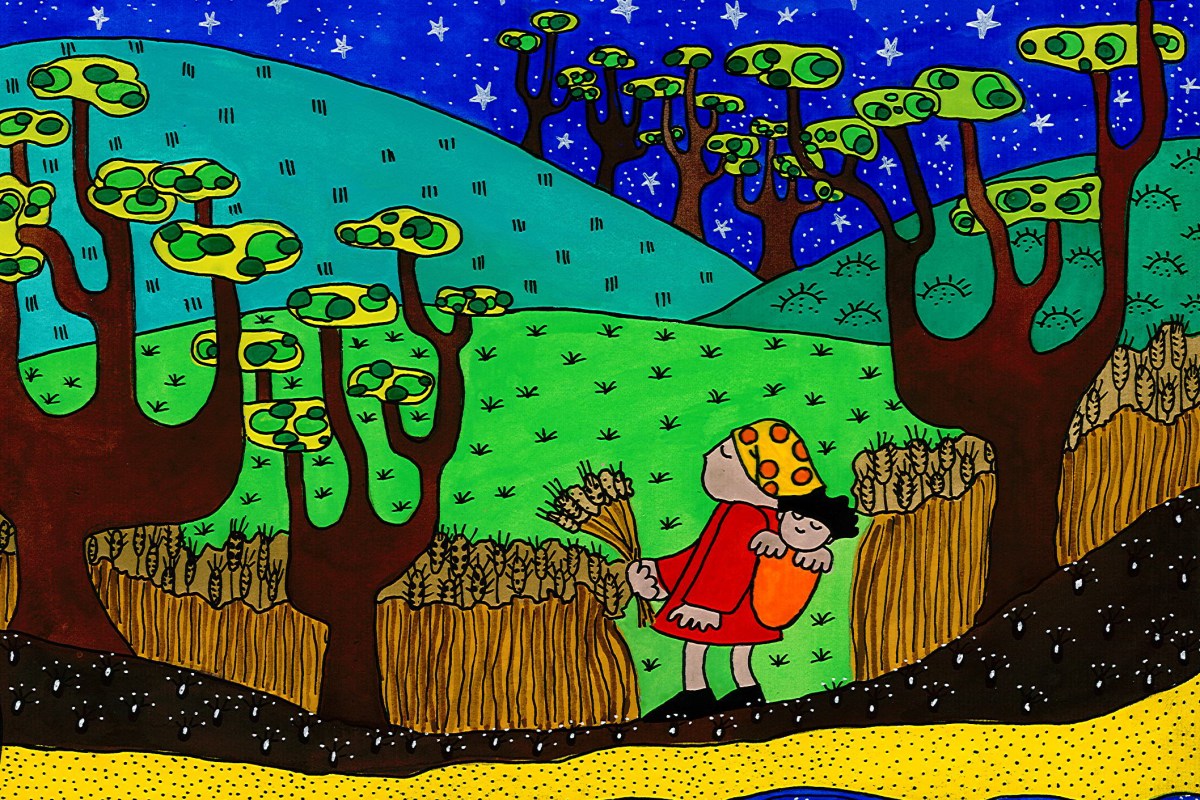
About the picture: Walking through a wheat field

august

In this picture I wanted to illustrate balance as it relates to motherhood. The earth is like a mother who feeds us and cares for us. In this scene a mom walks through the wheat field with her baby, evaluating the health of her crops. She picks a bundle to examine the wheat better. Her baby is close to her, watching and learning from his mom. Eventually the wheat that the earth has produced, will become flour, and the flour will become bread that feeds the mom and her baby. The mother relies on the earth for food and the baby relies on his mother for survival. A healthy earth produces healthy wheat, and healthy wheat produces nutritious bread, essential for the mom and the baby to thrive. As long as harmony exists in this cycle, life will continue to blossom. But it’s a delicate balance. A single element out of balance can affect the entire cycle and can lead to destruction.


If you want Change, Change your Actions

When my family arrived in Canada as immigrants, the first and most challenging barrier was not knowing the English language.We didn’t have a family member who could help us remove the web of restriction caused by our lack of understanding English. These were the 90s and there were no smart phones, nor clever translating apps to function as our interpreters.

My parents carried a pocket dictionary, and word by word we tried to make sense of the native tongue, culture, and the confusing new world. I remember how much of a struggle it was just to rent an apartment and fill the piles of forms written in the English language, not to mention applying for a job. For my parents the job market was limited to a handful of Polish companies that were willing to hire individuals who didn’t speak the language. Those jobs typically involved cleaning, caring for an infant or an elder, or some labour-intensive task in construction.

Luckily the Canadian government offered free English classes to recently arrived persons. And like thousands of new immigrants, my parents attended these classes in the evenings, after work. I was also learning English in an ESL (English as a Second Language) class, at my high school. However, by spending a major portion of my day studying English in an ESL class, it meant that I missed most of the regular classes I needed to take if I wanted to eventually attend a University.

During the 90s, students in Canadian high schools in the province of Ontario had the option to pursue three tracks: Basic, Intermediate, and Advanced. To be able to apply to a University, a student had to be enrolled in the Advanced track, and then take OAC (Ontario Academic Credit) classes in order to proceed with higher education at a college or university.

In my case, without knowing the English language, I was unable to enroll in the regular high school curriculum classes, let alone take these classes at an advanced level. The idea of attending a Canadian university, or even being able to apply to one, seemed near impossible from where I was starting.

There’s no such a thing as equal opportunity. Accept this and get to work.

Still, I haven’t given up. Those were the cards dealt to me, and I had to make the most of my situation. I was determined to learn English, because I understood that if I wanted to do anything with my life in an English speaking world, it all started with a solid language foundation. Having a voice and being able to communicate with those around me was essential. Regardless of my intelligence and knowledge. If I didn’t have the language to communicate my thoughts and ideas, what was inside of me would have no value to those around.

I spent countless hours on learning English. I remember at one point walking down the school library aisle, looking for the thickest book I could find. I came across War and Peace by Leo Tolstoy and determined to read it cover to cover. I spent a day reading the first page of this overwhelming book. It took time to look up the hundreds of words I didn’t understand and then try to make sense of the story. As I progressed through the book, page by page, gradually recognizing more and more words, towards the end I hardly needed the dictionary.

My motivation was the idea that if I could make it through such a challenging book, I would learn thousands of new words, and perhaps be able to eventually take English classes like the other Canadian kids. The possibility seemed exciting to me.

It took more than War and Peace to get me into the Advanced English high school class, but by grade 11, almost three years later, I was finally permitted to enroll in the Advanced English track and continue onto the OAC English. Eventually I was able to apply and get into University of Toronto, and realize my dream. And yes, graduate too.

Although the finish line might be the same, not everyone enters the course from the same starting point.

Looking back to where I started, the odds were probably not in my favor. However, with work and perseverance I managed to catch up with many other Canadian students in my class, many who didn’t have to squeeze learning the English language into three years.

However, in the end, did it truly matter where I started compared to my classmates? Or, what challenges I had to go through to get to where I wanted to be? On my university application no one was going to give me extra points or special consideration because I was an immigrant. What counted were my grades, the quality of my essay, and my test scores. This is all that the university review panel saw and based their decisions on to grant me acceptance.

The results of our actions are what matters, not intentions or the roads we had to travel to get to to our destination.

Personally, yes, what was most important to me was my journey, not the destination, because of all I have learned along the way. But to others, who had an impact on my academic career, it’s the effect of my efforts that was most relevant. It’s that piece of paper that told them that I could handle higher learning, not where I started or what challenges I needed to overcome to get a diploma.

Most people don’t care what you had to do to get to where you are. An employer is not going to care that your parents’ divorce caused you to slide on your grades and you didn’t get into the college you wanted, and don’t have the right degree. The guy you’re dating is not going to loose sleep over the fact that your relationship with him is suffering because his ex keeps interfering, if he does not see this as a problem and welcomes it. The scheduled flight to Paris will not hold for you because you were caught in bad traffic or had a flat tire on the way to the airport. And your boss will not be concerned that your job’s unpredictable schedule is preventing you from developing a serious relationship.

It’s easy to blame someone or something for why things are not going our way. And yes, it’s not fair that everyone does not get to start from the same point. Some get to start the race way ahead of us. And we may never get a chance to catch up to those in the lead. But life is not a competition. It’s about making the most of what we were given or have, and piece by piece build the best version of ourselves; a version that makes us happy.

Maybe that means changing jobs, or careers. Maybe it’s starting a new exercise routine or by dropping bad habits that slow us down. Maybe it’s as simple as putting that phone down. Going for a walk to give ourselves some head space and clear the noise that distracts us from listening to our own intuition and where it wants us to go.

The power to make a change to attempt to get the result you want, lies within you. If you don’t make a change in your actions, don’t expect the result to change. A different result requires a different approach. Expecting a different result by doing the same thing each day, only leads to frustration. Screaming and crying for change yields nothing, only by changing our actions can we expect the results to change.

Because when you meet others who don’t know who you are, most of them are not interested in the obstacles you had to overcome to end up where you are today. What interests others is the kind of person you are today, here and now, and the effect of all the journeys you’ve taken to arrive here.

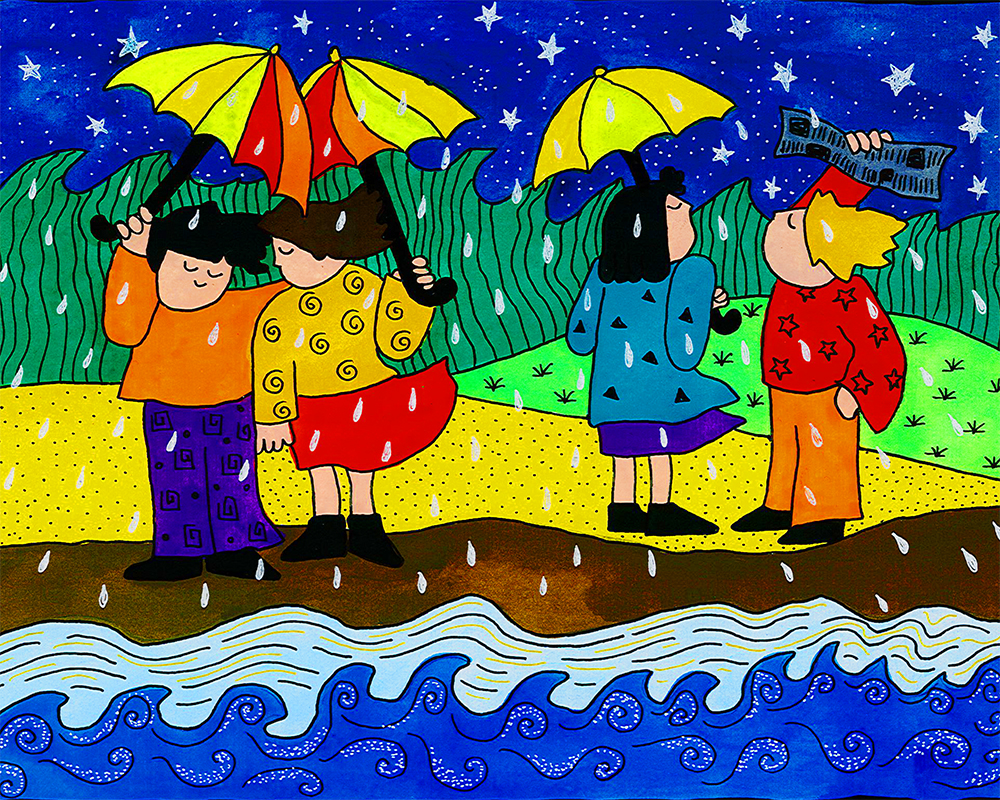
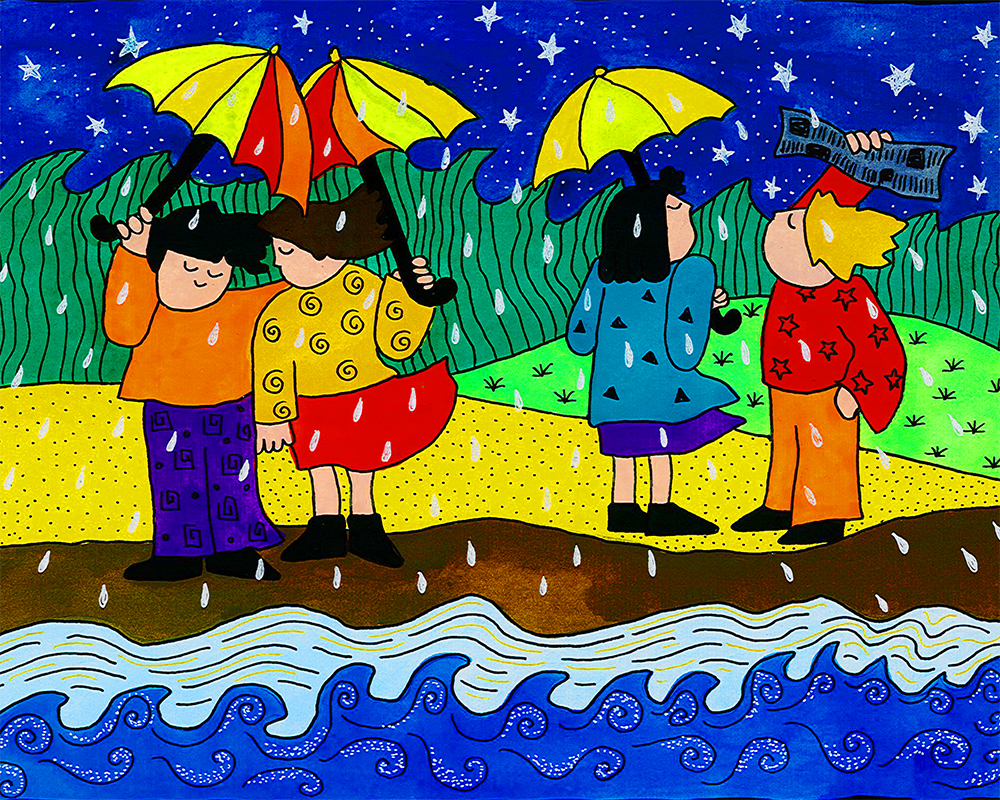
About the picture: Caught in the Rain

raining

When painting this illustration, I was thinking of the time when I was caught by the rain while forgetting to bring my umbrella. All around me I saw others pop open their nifty colorful umbrellas, enjoying the comfort of staying dry as they marched on. I got completely soaked that day because I was not prepared, nor protected. The world seemed so harsh and cold.

I wanted to illustrate a similar scene, with a boy who is getting wet because he didn’t bring his umbrella. The umbrella stands for protection, and without it he is vulnerable. While others will arrive comfortably dry at their destination, he will be wet. This is the consequence of him not being prepared, for whatever reason. He is resourceful though, and uses a newspaper to shield himself as best as he can. Maybe the person next to him will let the boy come under her umbrella for some protection? But is she walking in his direction, or are they going the opposite way? Will he join her, and change his course, or will he go his way and risk getting further soaked by the rain? Either way, he must make the best of his situation and get to a cover, or continue towards his destination. Of course the rain will eventually stop, this is the hope, symbolized by the sky filled with stars. Because just like circumstances, the weather changes too. And the sun will come again.

The High Price of wanting something Different

A few years ago I needed to replace my front door. Like most homeowners I went to my local hardware store to look at some door styles. The shop had about five different types on display. Available for purchase immediately in standard sizes. In addition, there was a catalog with dozens of more elaborate door designs to choose from and more size options, however those models had to be special ordered and required a few extra weeks to be delivered.

Other stores did offer a few more selections, but none sold the door I was looking for. Except for the number of panels, the hundreds of door designs I saw, all seemed to look the same. Stylized after the local and popular colonial model. The only feature that distinguished them was the glass design. Some had birds etched on them, others had flowers, while the rest had some kind of graphic patterns. Ultimately, the door designs were far too ornate for my taste. I was looking for something simple.

Wanting something different is considered exceptional, and exceptional carries a high price

It surprised me that it was easier to find an elaborate door design over a simple one. It’s like being in a mood for a plain bagel, but all you can find is poppy seed, sesame, onion, blueberry, or sun-dried tomato flavors. Everything under the sun, but no plain bagel in sight.

My search took me to all kinds of showrooms. And eventually I did find a door I liked, but it was custom made, and instead of $1,000, the sticker price was $15,000. What bothered me most though was that the architecture of my dream door was the simplest of all the designs I’ve seen. It had clean lines, and none of the fancy glass features. It’s like finally finding a plain bagel, but it costs more than the one with all the fancy ingredients. It made zero sense to me.

So why was it so much more expensive? My first guess is maybe because majority of the houses in my area are colonial style and therefore most customers choose to buy colonial style door. My house happened to be a contemporary one, a rare occurrence in the neighborhoods packed with these colonial-style cookie-cutter homes. So, for having an exceptional house, I would either have to slap a door that didn’t match the building, or pay a hefty sum to get the door that fit.

Going with the current rather than fighting it, takes less energy, but the current might not take you where you want to go

I felt annoyed by the limited options: either conform and buy what the masses bought, or pay the extra bucks—a lot more extra—and get the right door for my type of a house.

It’s not in my nature to conform and I couldn’t pay $15,000 for a door. There had to be another way. I decided to do some research outside of the retail market and search through the local carpenter listings for someone who could help me build a simple door. Most refused or proposed outlandish prices. And after a month of research, I almost gave up. That’s until one of the carpenters reconsidered and called me back. I was fortunate he did. After examining my door design closer, he agreed to do the job for half the price. Still not cheap, but something I could afford. He seemed to have a passion for working with wood and obviously this was more than just a job for him. I was thrilled, and after eight weeks, I finally had the right door for my home, without breaking the bank.

Refusing to settle and choosing to chase a dream requires deliberate action and hard work

So why bring up this renovation story? Well, I often compare this homogenous door-market experience to situations in life. For those who accept or are happy with the one-size-fits all packaged life and execute each step as expected: go to school, get good grades, graduate, get a job in some office, marry, get a house in a nice neighborhood, have a couple of kids, maybe even get a pet, and live happily ever after… then that door, sold at the local hardware store, will work for you. It’s a functional door and readily available. That door will close and open, keep your house safe when locked, and the birds etched on the glass might even bring you a smile. And if you happen to live in a colonial-style house, then you have everything you need at your doorstep.

Trouble is when you want a custom life, one that doesn’t fit the standard sold to the masses. Then your options become limited. You will either need a lot of money to fulfill your custom dreams, or conform and somehow endure the cookie-cutter life. Either way, you pay a high price for wanting to live a life that fits your needs rather than what society expects. Some folks are able to endure this, but pay it with frustration or isolation. Others embark on the road of making loads of money so they can pay for their custom life.

The danger with pursuing money is we risk losing our objective, because money functions primarily on a superficial level and happiness that it generates is often temporary. And in those cases, instead of being treated as a tool, money often becomes the goal.

On the other hand, if we resolve to live with the frustration caused by the standard that doesn’t fit us, and deny our core desires, we run into the danger of having all those suppressed yearnings erupt and potentially cause some serious damage, such as losing our job, house, spouse, family or friends. Either way, there is a price.

There is always an alternative, but we need to be creative in finding it

I like to think that there must be a road somewhere in the middle too. But that one takes time, work, and deliberate action. It takes discipline too. It requires us to take initiative to define the goal or dream we wish to realize, and then find resources and tools to make it happen. It requires creative solutions.

Maybe that means waking up earlier one hour each day to spend on learning something we wish to be doing for our living eventually. Or maybe it’s as simple as taking a cooking or a language class. Maybe it’s by stating and verbalizing our desires, rather than assuming that what we want is understood by others. No matter what it is, without action, our dreams remain a fantasy. A custom life requires action and work on our part. Action, that gets you a step closer towards the life you want. And even though the results you want will not be immediate, it’s a step in the right direction and a step closer to your goal. Each single step like this brings you closer and closer to fulfilling your dream. It’s better to crawl towards your destination, no matter how far, than just to stand in one place and stare at it.

But it will not be as simple as walking into a hardware store and buying a door off the shelf. It will take research, time, and persistence to get the door or the life you want. Because the masses don’t know who you are and what you want. The masses only understand the voice of a group, not the individual. You’re the only one who has the blueprint for your custom life and only you can build it. And maybe if you’re lucky, after a long search, you’ll find that passionate carpenter or someone who wants to help you along, and who will give you a hand. But even then, it’s a good idea to keep that blueprint in your pocket, so you don’t stray too much from your design.

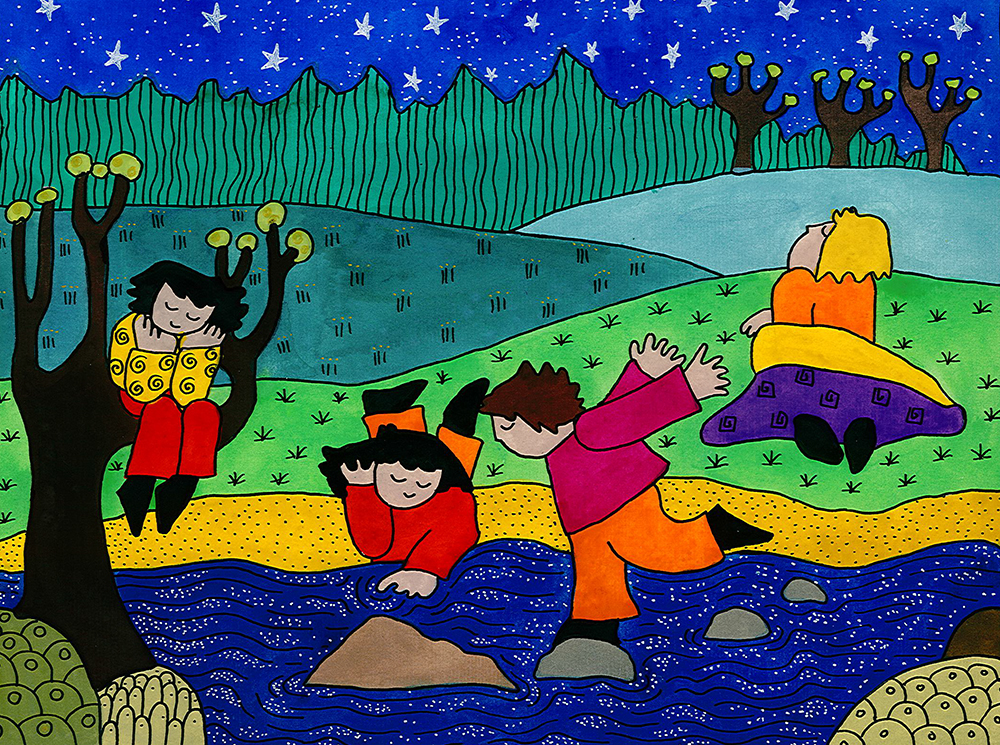
About the picture:

finding-the-right-path_j-lange

The water is simmering and flowing fast, but the surrounding land is stagnant. People who are next to this free flowing river are either pensively staring at it, hesitantly dabbing their finger in it, or jumping across it. A boy on the right has been sleeping and he is slowly waking up, but he can’t see the river because he’s turned away from it. His attention is captured by the vast sky above and he can’t see the earth below. Everyone on this picture has a dream, but not every person is acting on those dreams. While one boy is jumping across the river on the boulders to get to the other side of the water, and realize his dream, others are just sitting there. One boy is stuck in a tree, thinking about his dream, but he does not know how to get off the branch because he fears that he will fall into the fast-moving current underneath his feet. A girl on the shore is curious, but lacks the courage to take the plunge, so she gently touches the water with her finger and plays it safe. But testing the water is not enough to get her across. It only gives her a taste of what she’s missing. Only the boy who’s not afraid to jump across, from boulder to boulder, will be able to get to his goal that’s on the other side.

Learning to pause when everyone is running

During the 80s, my family ended up in Italy, after a long journey that started in Poland. The shift was radical, and the two cultures couldn’t be any more different. The Italian people walked with a bounce in their step. They laughed frequently, were expressive, and beamed of excitement during interactions.

The iron curtain, separating Eastern and Western Europe, rested heavily on its citizens’ shoulders. And its effects could be seen in people’s stern faces and rigid gestures. Heads were bent towards the pavement, expressions were serious, and the eyes reflected fear. When one had to fight for every little thing, even a gray roll of toilet paper, it’s no wonder that the system created a population of stressed out and nervous individuals.

A very important Italian lesson

But moving beyond the obvious cultural variances, the most stunning difference was that Italians were given time in the afternoon to rest. And I am not referring to a half-an-hour, or even an hour, for lunch. I am talking about a serious chunk of time; three to four hours right in the middle of the day. In Rome, where we lived, it is called a ‘siesta’, but some Italians also refer to it as ‘riposo’.

In any case, it was impressive that almost the entire country would shut down to enjoy this personal time to rest. To pause, to eat, to reconnect with their families and friends, to reflect, or simply enjoy doing noting (far niente!). This idea was so foreign to someone like me, who was schooled from very early on to work hard and to be productive at every opportunity.

Of course it doesn’t help that by nature I am most happy when I am in motion. But being in motion and being busy for the sake of being busy are two very different things.

Despite my natural tendency to keep on moving, over time I developed a great appreciation for this regular pause during the day. It was special to have this time just for me. To have a few hours in the afternoon to stop and enjoy life. To look around me and to not rush. To take it all in and absorb my thoughts and process the events of the day.

Doing busy work can be a trap

Time is precious, no doubt. But it doesn’t mean that by taking a pause for reflection, time is being wasted. In fact I believe the opposite. By taking time for ourselves to contemplate, to examine and to listen to our thoughts and desires, we take bigger strides. Just because on the surface we see many people around us running, and it feels like we’re standing, it doesn’t mean that by running they are on the right course, or going any further than us. If they are running in the wrong direction, they are moving backwards. Some people run for the sake of running. Doing busy work as a way to escape the effort to think for themselves and to figure out the direction they want to take to make themselves happy.

Take time to reflect and get to know yourself

Chasing the idea of happiness, but not taking the time to understand what happiness means to us as an individual, can often lead to disappointments and frustration. Sometimes years go by before we realize that the very thing we were chasing was the wrong dream all along. The sooner we figure out what makes us happy, the more time we will have to chase the right dream for us, and make it a reality.

Learn to disconnect

I realize that having a career, family, friends, and other obligations can pull us in different directions, and there are days when even a half an hour for ourselves can feel like an eternity. However, it’s funny how I often run into people who claim they are too busy to take time for themselves, but yet manage to post something daily on social media, play video games, or spend time watching TV and catching up on the news, rather than taking a walk in the park and think. And by taking a walk outside, I mean leaving the smartphone at home or in the office. Truly learning to disconnect from all the noise, and instead connecting with nature and ourselves. Electronics can often be the source of distraction–a distraction from thought and contemplation. Learning to walk away from that type of distraction can be very difficult at first, but also very revealing eventually. Take the time to do so.

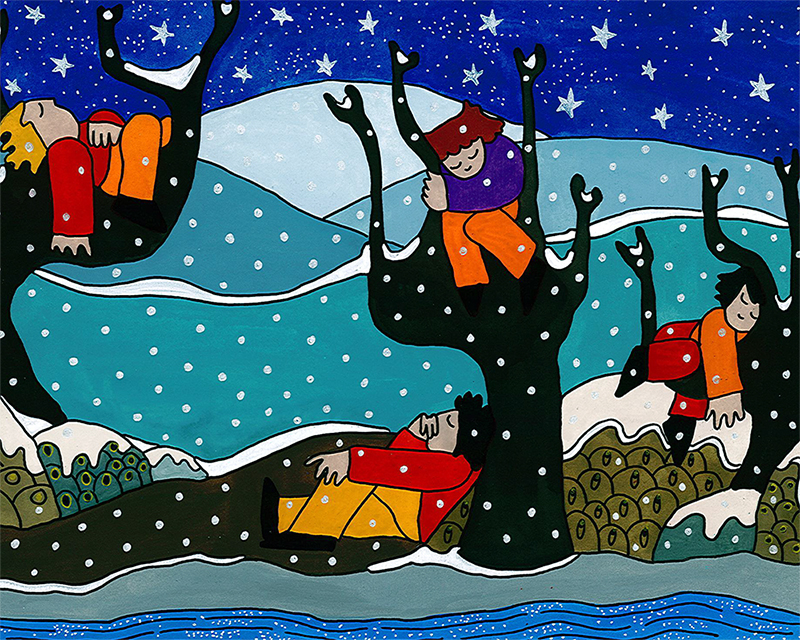
About the picture: Winter Sleep

Winter scene_8x10

In this scene I decided to scatter multiple people on different planes to symbolize their level of reflection. Some have their heads pointed towards the sky, while others towards the ground to show the expansion of their thoughts. There are people holding to bare branches as if to gain a bit of warmth, while others are barely hanging on, and appear like they are about to slide off the tree as they are deep in sleep. One person is resting by the tree trunk, holding their hand near their mouth to symbolize introversion and inward expression rather than proclaiming words. They are outside in nature, tuning into the rhythm of winter and sleep as they are bound to the trees. The bare trees are also in their resting stage. Above them is a starry sky, signifying the bigger world around them, potential, and most important, hope. Because hope is what will help them get through the winter.

Living is taking risks

I was in my late 20s and living in Toronto. My life was on an upswing. I got a promotion with better pay, bought a house, and was in a stable relationship with someone for more than three years. I felt optimistic about life and already started to make plans for the next stage. That is until one winter day I received a letter that would change my plans, and eventually my life.

It’s the little things that often make the biggest impact

In general I found that big changes don’t happen overnight, they usually develop over time from what at first appears to be a simple decision or from a series of small decisions.

About eight years earlier I filled out an application for a U.S. “green card” and citizenship. At the time I figured that U.S. was the place to be if I wanted to make anything of myself. Therefore, when an opportunity came up to submit a form for U.S. citizenship, I though, what the heck, I have nothing to lose–so I applied. Several weeks after applying, the response I received from USCIS was not encouraging. And months–then years later–it didn’t even seem like my request was going anywhere. So, I forgot about the whole thing and kept moving my life forward in Canada–and it was definitely moving forward.

Careful what you wish for, or you just might get it

That is until years later I received a notice that my application was finally approved and that I had six months to pack up my stuff and move down south. What? I thought. Now you’re telling me to move? Just when things begun sailing so smoothly.

Life has an odd sense of timing.

I was faced with a choice: do I stay in Canada and continue my comfortable life here or do I risk it all for a chance to build a new life in the U.S.? I would be giving up a lot for an unpredictable dream. Was it worth the risk?

My boyfriend at the time certainly didn’t think it was a good idea to move. Also, many of my friends were getting married and some were even starting families. And here I was, contemplating to jeopardize a perfectly good relationship when instead I should have been seriously thinking about marriage and children. Not to mention the fact that I was also intending to walk away from a stable job for something totally unknown.

Give yourself a chance to find out what you want

There was a lot of pressure to stay and continue on my current path, but something inside kept telling me to give myself a chance and take the risk. If not now, when? And it’s not like my boyfriend was in a hurry to get hitched or have a family. Frankly, neither was I. After all, why rush something so important just because others were doing it?  And if after three years we still weren’t ready to tie the knot, would another year or two make a difference? Having more time together wasn’t a guarantee.  I even wondered if perhaps some force threw this twist into my life to test his and mine true intentions.

After months of debating in my head, I decided to make the leap and move to the U.S. Needless to say, it was not a popular decision. But I was happy with my choice and stuck to it.

Don’t get discouraged after the first fall

Starting a new life in the U.S. was not exactly easy. I faced many challenges with work, health insurance, housing, and adapting to the new culture. During my first months in America I felt very alone and I often considered turning back around. As I was crossing the U.S. border I remember hearing a jolly plump woman saying, “God helps those who help themselves”, and somehow that phrase cemented my first impression of the U.S. Hearing it upon entering this country made it clear to me that in America learning how to be independent is the key to survival. And if I was going to make it here, it would be primarily by relying on my own strengths and not to expect too many handouts.

But I certainly did not regret taking the risk. And as I settled into my new job, somewhat assimilated to the culture, and started developing friendships, life begun to look bright again. In fact, two years after my move, I built a new life that was better than I ever imagined back in Canada.

Learn to conquer your fears

It can feel scary to let go of something that has been a part of our lives for a long time. I know many people who hang on to mediocre jobs, stale relationships, or stifling routines, for fear of disturbing the status quo and possibly making things uncomfortable and even worse off for themselves and even others. So instead, they choose to accept the middle-of-the road deal, rather than aim for something higher. And for some, an ordinary life is exactly where they prefer to stay. After all, why stir the pot when all is good? But what if others are stirring the pot (someone has to) and one day they decide to stir it in such a way that ends up disturbing our own perfectly good life?

It’s naive to think that everything will remain the same as long as we don’t take any risks or make any radical changes, because we don’t live in a vacuum. Eventually change will happen and it is up to us whether we’re the catalyst behind that change or someone else dictates it for us. Chances are that if we initiate the change or embrace it rather than fight it, the results will be more appealing and easier to adapt.

And for individuals who need more out of life to feel fulfilled, somewhere along this path lies risk; risk in giving up a good paying job for one that might help you realize your passions; risk in losing a convenient relationship for one that may bring you true love; risk in forgoing popularity for a chance to maybe meet your greatest friend; and so on. And I use words such as ‘might’ or ‘may’ deliberately because the whole point of taking a risk is that you don’t have any assurances that the result you’re after will materialize. There is a possibility that the consequences of taking a risk might be less than desirable. But never knowing can be far worse.

Take risks, but avoid being reckless

Yes, risk is part of living, but I would like to add that there is a difference between taking risks and being reckless. We all carry certain responsibilities or have commitments that we adhere to for many good reasons. And risking something that would seriously affect these obligations, would most likely bare heavy consequences and lead to some kind of a loss or hurt–not just to ourselves, but others too. And risking someone else’s well being is reckless.

Some of my greatest experiences and lessons came from overcoming my fears and taking risks. And I don’t necessarily mean by uprooting my entire life or jumping off a cliff. Sometimes the risk was simply in asking questions or by taking initiative.

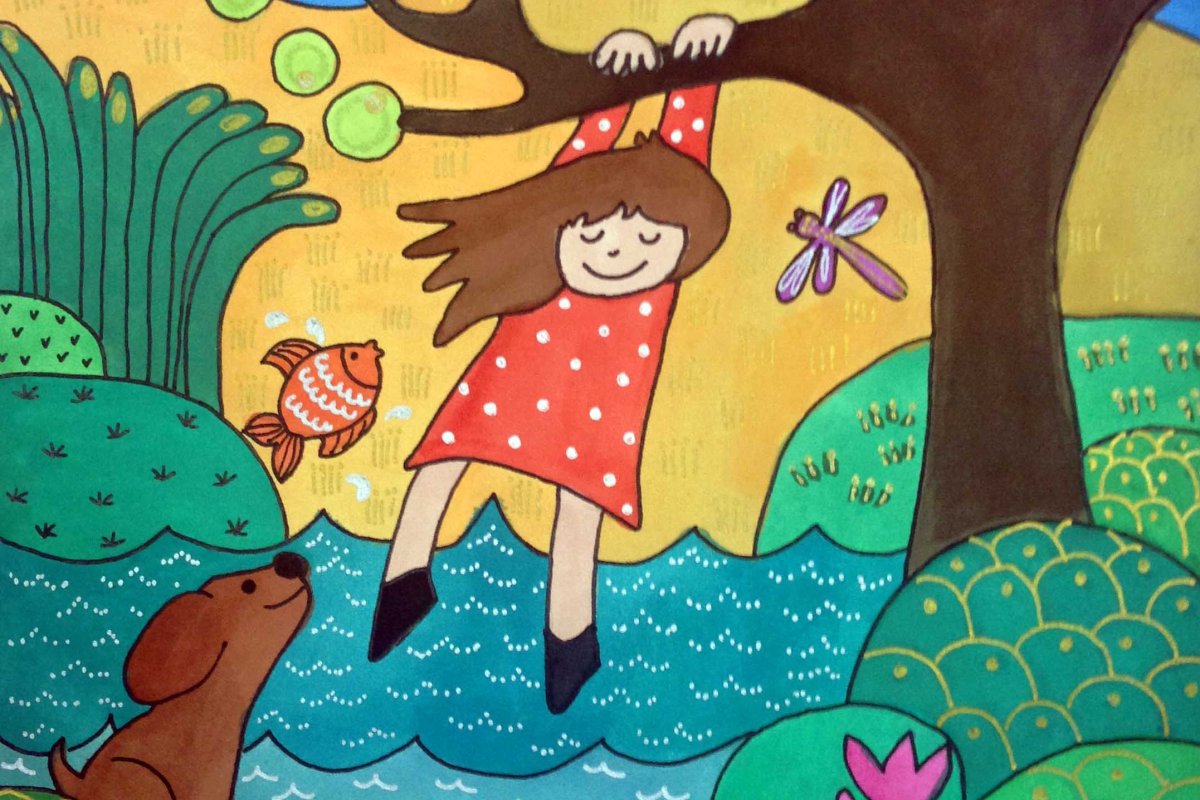
A girl swinging off a tree branch

girl-swining-from-a-branch

On this picture I wanted to illustrate a girl who is not afraid to leap in. She wants to cross to the other side of the lake. She is curious and craves to discover what lies beyond the large body of water. She finds a good branch that she can hang on to and uses it to swing across. She feels excited about exploring something new and her mind is open. The dog watches his swinging friend and cheers her on. He wishes that he too could swing from a branch like she can. In fact he’s so excited that he tries to stretch as far as he can to be as close to his leaping friend as he possibly can without falling into the water. Even the fish is jumping out of the water to watch this girl as she’s suspended over the water and is about to make her jump. She’s not afraid.


Image

Got to keep moving

Growing up in a country that restricted its citizens’ travel, fueled my desire to travel even more. In communist Poland one couldn’t own a passport. You were able to borrow it from the government to travel for a certain period of time, but you couldn’t hold on to it. In addition you had to ask for permission from the government to allow you to travel. There were loads of forms to fill out and long application lines to stand in just for the chance to ask the government for permission to let you out of the country. And most countries were off limits to average citizens like us. We were able to go to Czechoslovakia or Hungary for example, other communist countries, but West Germany, United Kingdom, or United States was a total fantasy. Only few were fortunate to go that distance.

Conquering restrictions

But our family hated restrictions. We did everything we could to stay mobile. If it wasn’t a trip to the beach, it was a drive to the local lake or a camping trip. And when I felt like I was stuck, I hopped on my bike and rode all over the neighborhood.

Mobility means freedom

It was an old bike, one my dad had as a kid called Karate. From the very first moment I sat on it, I knew I was in love. My bike and I were inseparable. We spent hours and hours together and my day was never boring as long as I had my bike by my side. I could go to new places, see new things, and be an explorer. As long as I had my bike, I had mobility and to me being mobile meant being free. My bike was my freedom and freedom meant happiness.

Freedom is an essential part of happiness

Today I still feel that when I am in motion I am happy. When I am walking, running, riding my bike, driving, riding the train, or flying on a plane, I feel a sense of joy overcome me. I love being in motion and the feeling of anticipation of what awaits me around the curve, and what I will discover next on my journey. And it’s never about the destination, because that usually signifies the end of me staying in motion.

Battling stagnation

Despite having an office job, I still find ways of staying in motion by either biking to work, running during lunch, walking the long way to my favorite cafe or lunch place, or simply by getting up and going for a 20 minute walk, regardless of the weather, because I know that even on a bad day, my mood will improve if I am in motion.

The Girl on a Bike

Bicycle

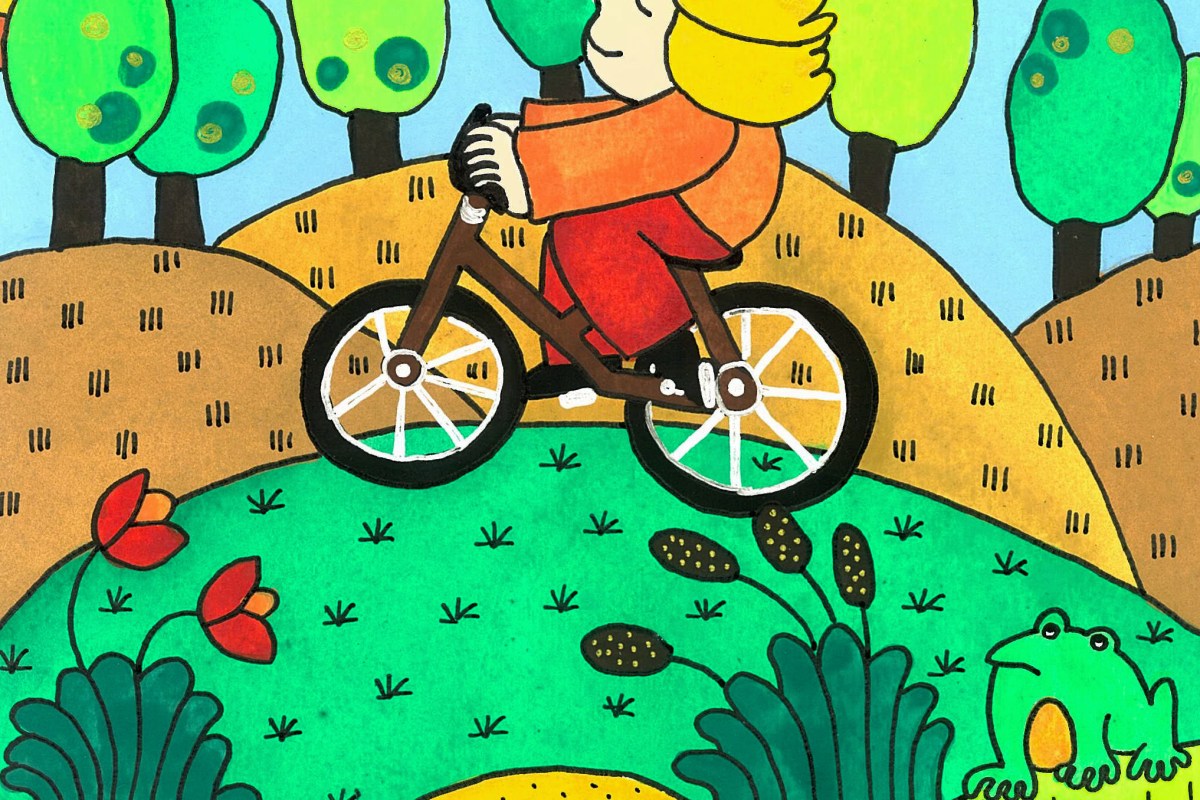
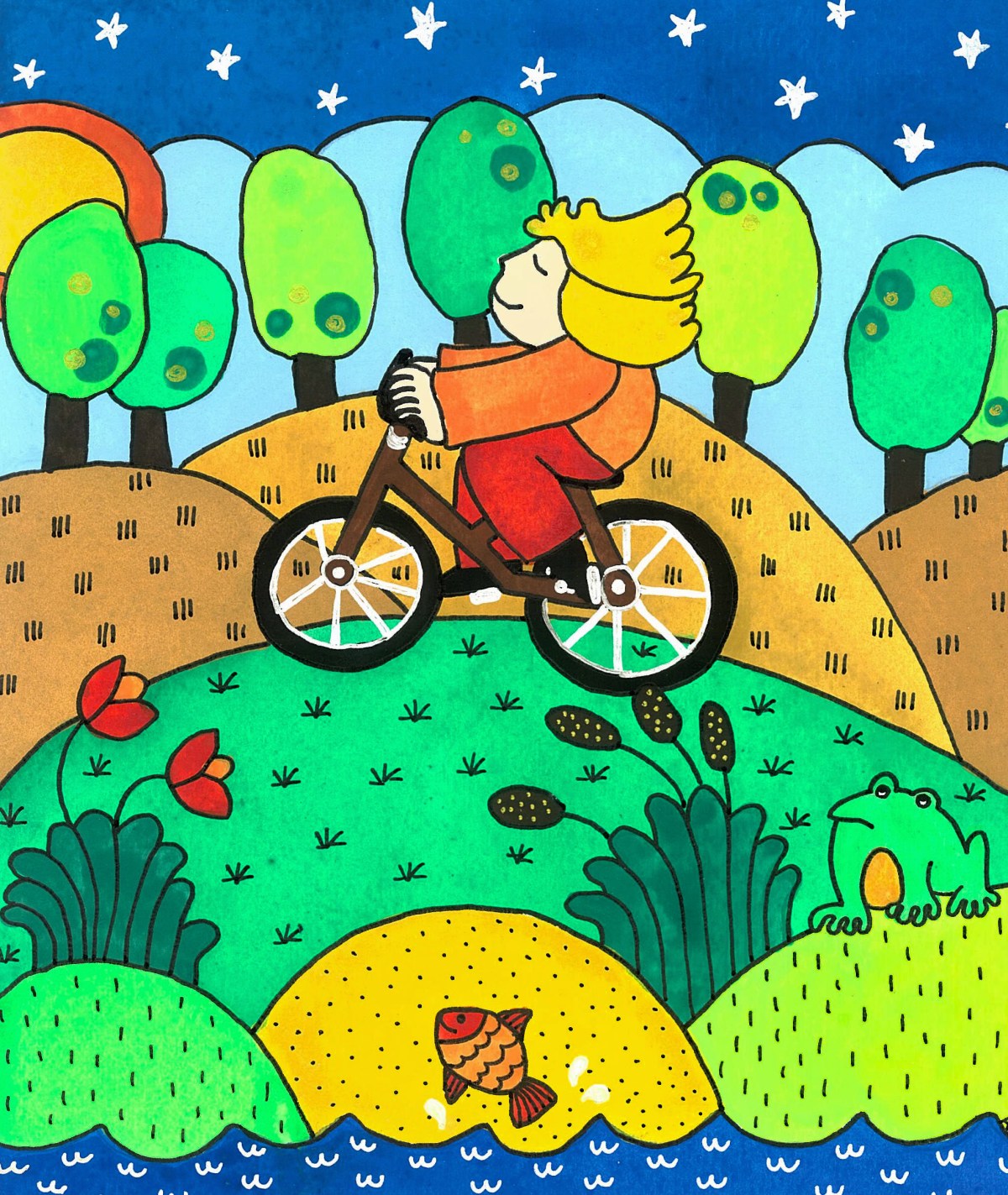
On this picture, I wanted to capture the very essence of happiness while staying in motion. The girl is looking forward as she goes by the frogs, the birds, the trees, and the flowers. The wind is blowing in her face and she feels connected with nature, and therefore she is connected with herself. She is right here in the moment and enjoying her bike and the freedom she feels while riding through the hills and valleys. In this moment she is on top of the hill. She climbed a long time to get to the top of it, and she feels a sense of satisfaction that she has worked hard to get here–a place from which she can see the road ahead and is free to move ahead.


All you can bring is your backpack

This is what my mom said, as she woke me up at 3:00 am one summer night. I was 10 years old and we were living in Poland. These were the 80s and Poland was a Communist country. I got up as I was told. Packed a doll, a few books, colored pencils, sketch pad, and a summer dress, with blue stripes and little boats on it. Then off we went into the night. I didn’t know where we were going. I was told to be quite and avoid making noise. Once we were on the train to Warsaw, I was told that we were going on a vacation.

Nothing is forever. Suddenly everything can change.

I was unaware that my parents were escaping Poland that night. Everything I packed in my small back pack in a rush to leave, was all that I was taking with me on this mystery journey. I had no way of knowing that as of this night my life would never be the same.

My parents couldn’t tell me what was really happening, because if for any reason I were to slip and reveal their plan, we could have been thrown in jail or, who knows, even worse.

Capturing the picture in my head.

When I picture that night, I remember darkness; a lot of it. My head was filled with questions. I didn’t know where we were going and why I was being woken up in the middle of the night. It bothered me that there was so much secrecy surrounding this trip. None of it felt natural. I felt scared, yet excited at the same time, because there was something unusual in the air.

Start of a Journey

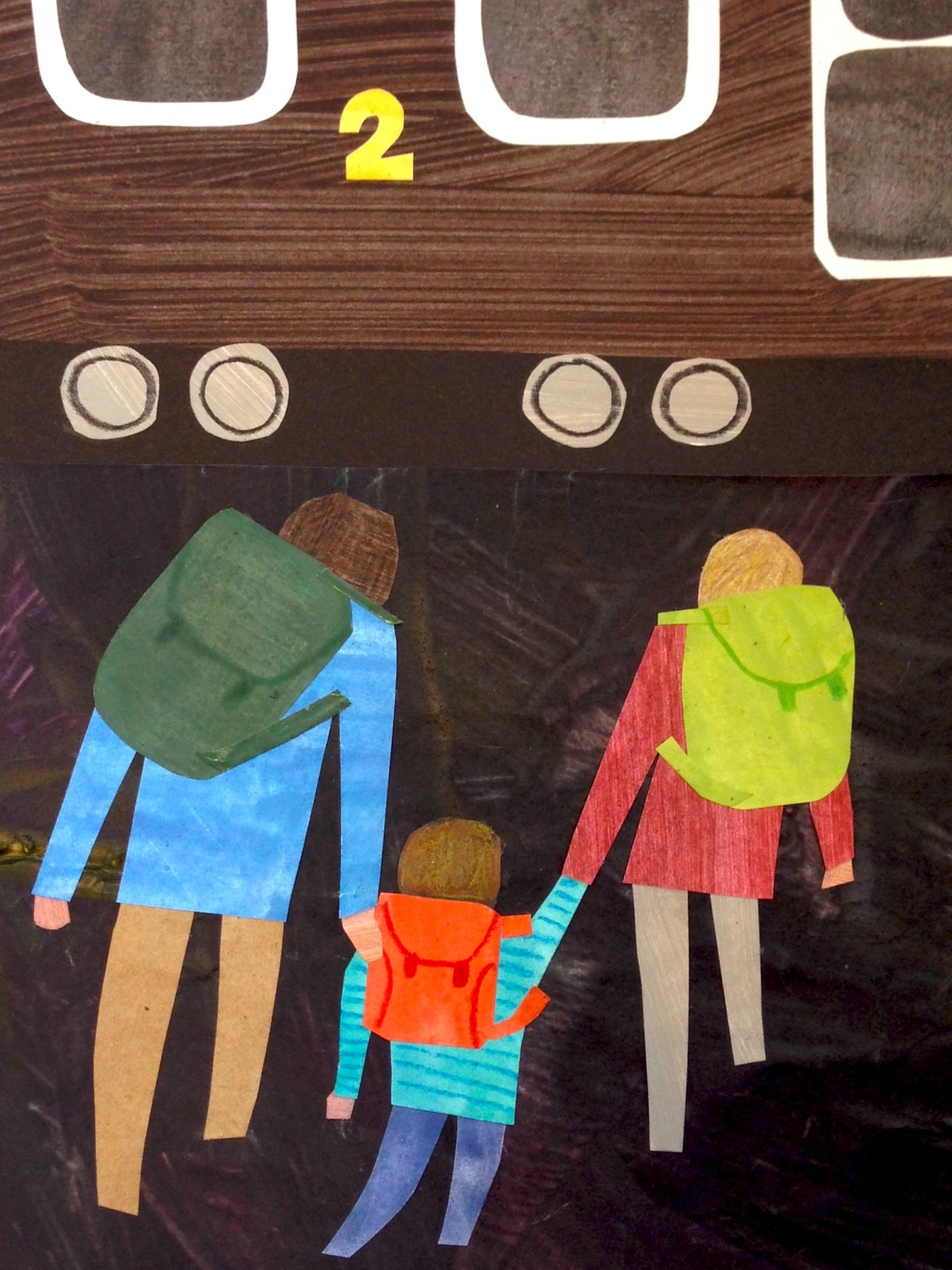
Trying to capture one moment from that night, I chose to create this picture, called “Start of a Journey”. As this blog is also a start of another journey for me, I thought this would be a very fitting way to begin.

Start of a journey

Typically I like to fill my illustrations with bold colors that energize my pictures. I enjoy energy; especially positive energy. And I like when my art inspires positive feelings and happiness in others. As such, I typically choose colors that stimulate a pleasant mood. These include bright reds, oranges, electric blues, and light shades of green. However, in the case of this illustration, I chose a very somber palette, unusual to my style; a lot of dark colors in unattractive shades of brown.

The figures are my parents and myself as a child, being pulled and slightly dragging my feet, suggesting hesitation. We’re wearing bright colors, because we are filled with hope. Hope for a better future is driving us to take make this journey. We’re walking towards a train, but it’s hard to tell because from my angle I only see the bottom portion of the train and a large number two written on the wagon. The number two stands for “second class”, suggesting that as refugees, we’ll be often treated as second class citizens who are trying to find our second home.

Let go and embrace change.

Sometimes I look back on that deciding moment during my childhood and relate it to life in general. Life can change at any moment, you can’t always anticipate the direction it will take. Letting go and adapting to change can not only help you open the doors to new experiences and even a better life, but moving on can help you grow and evolve.

In my case, as difficult as it was to leave our family and friends, home, familiar environment, language, and our entire life behind, eventually we ended up being better off. We built new friendships, we bought a new home, we learned a new language, we build a better life that suited our needs. We eventually found happiness.

This is not to say that it was easy. Anything that matters, is not easy. In fact, the beginning was brutal. It was one of the toughest things I experienced. Escaping through the heavily-guarded borders at night, living the life of a refugee, sleeping on benches at the train stations, not having a home, not understanding the language, not having a job or a school to go to. That was rough and there were days that we wanted to turn around and go back. Something however told us to keep moving forward. So we did.

You can always build again.

Starting all over again was scary, but without taking that risk, my family probably wouldn’t accomplish as much as we did by taking a chance and leaving behind what we have outgrown.

The lesson I learned very early on, is that holding on to something you have outgrown, only prevents you from growing and evolving yourself. And even though you’ve invested years on building something, don’t be afraid to let it go. Remember, you can always build again. And no, probably it will not be the same, but who knows, it might be better in the end. In fact even if it isn’t, you can always build again, and again. And each time you build, you learn to be a better builder. And no, I am not referring to building a house or a structure; I am referring to learning how to solve and overcome problems to build a better life. So don’t be afraid to let go, learn how to be a great builder, because nothing is forever. But if you know how to build, you’ll at least know what to do when faced with loss or a challenge.